[Classic Paper Review] Space Debris Environment Evolution — Earth Satellite Population Instability
2026-06-29
Space Debris Environment Evolution — Earth Satellite Population Instability
Paper: J.-C. Liou and N. L. Johnson, "Earth Satellite Population Instability: Underscoring the Need for Debris Mitigation," NASA Johnson Space Center, 2008.
Affiliation: NASA Orbital Debris Program Office, Johnson Space Center
1. Introduction: The Kessler Syndrome and Debris Environment Evolution
The space debris problem did not emerge overnight. Since Sputnik 1 entered orbit in 1957, human space activities have accumulated over 9,000 cataloged orbiting objects in Low Earth Orbit (LEO) with a combined mass exceeding 5 million kilograms. However, the most alarming concern is not the current number of tracked debris objects, but rather the future evolution trend of the debris population.
In 1978, NASA scientists Donald J. Kessler and Burton G. Cour-Palais made a disturbing prediction in a seminal paper: when the spatial density of objects in certain LEO altitude regimes exceeds a critical spatial density, the rate at which new debris is generated by collisions will surpass the rate at which objects are lost through atmospheric drag decay. At that point, even if all launch activities were to cease, the debris population would continue to grow through collisional cascading — a process later termed the Kessler Syndrome.
The 2008 study by Liou and Johnson, using the high-fidelity three-dimensional evolutionary model LEGEND (LEO-to-GEO Environment Debris model) developed by NASA's Orbital Debris Program Office, systematically demonstrated a sobering reality: even with a complete halt of all future launches, the LEO debris population will continue to grow beyond 2050 due solely to random collisions among existing objects.
2. The LEGEND Model: Three-Dimensional Debris Environment Simulation
2.1 Model Overview
LEGEND is a high-fidelity three-dimensional physical model capable of simulating the historical evolution and future projection of the debris environment from LEO to GEO (Geostationary Earth Orbit). Unlike earlier simplified analytical models, LEGEND possesses the following core capabilities:
- Historical Environment Reconstruction: Calibrated against cataloged data from the U.S. Space Surveillance Network (SSN) to match the known debris environment from 1957 to the simulation start epoch;
- Future Explosion Simulation: Uses Monte Carlo methods based on historical explosion statistics to simulate future on-orbit breakups of intact objects;
- Collision Probability and Debris Generation: Computes collision probabilities between orbital objects and employs NASA's Standard Breakup Model to generate collision debris clouds;
- Orbital Decay: Accounts for perturbations including atmospheric drag and solar radiation pressure to simulate the natural decay of debris objects.
2.2 The Monte Carlo Approach
LEGEND's future projections adopt a Monte Carlo methodology. Within each time step, the following procedure is executed:
- For each intact object (rocket body or spacecraft), estimate its probability of explosion within the time step, $P_{\text{exp}}$, based on its type and historical explosion rates;
- Draw a uniformly distributed random number $r \in [0, 1]$ and trigger an explosion event if $r < P_{\text{exp}}$;
- For each target-projectile pair, compute the collision probability $P_{\text{col}}$ and determine whether a collision occurs using the same random-number comparison;
- If a collision occurs, classify its type (catastrophic or non-catastrophic) and generate the corresponding debris fragments.
The critical criterion: a collision is classified as catastrophic when the ratio of impact energy to target mass exceeds $40 \text{ J/g}$, resulting in complete fragmentation of the target. This threshold is derived from ground-based hypervelocity impact experiments.
Due to the inherent randomness of the Monte Carlo method, LEGEND executes 50 independent simulation runs (each covering 200 years) for each scenario, with the final results taken as statistical averages with a standard error of approximately 5%.
3. Key Findings: Population Instability
3.1 Critical Assumptions
To isolate the "pure" effect of collisional cascading, the study adopted conservative assumptions:
- Zero future launches: No rocket bodies or spacecraft launched after December 2004;
- No active disposal: Existing spacecraft do not perform post-mission disposal maneuvers;
- Natural decay only: Objects are removed solely through natural forces such as atmospheric drag.
Under such extreme assumptions, if the debris population still grows, it means the Kessler Syndrome is already triggered or soon will be irreversible.
3.2 LEO-Wide Population Evolution
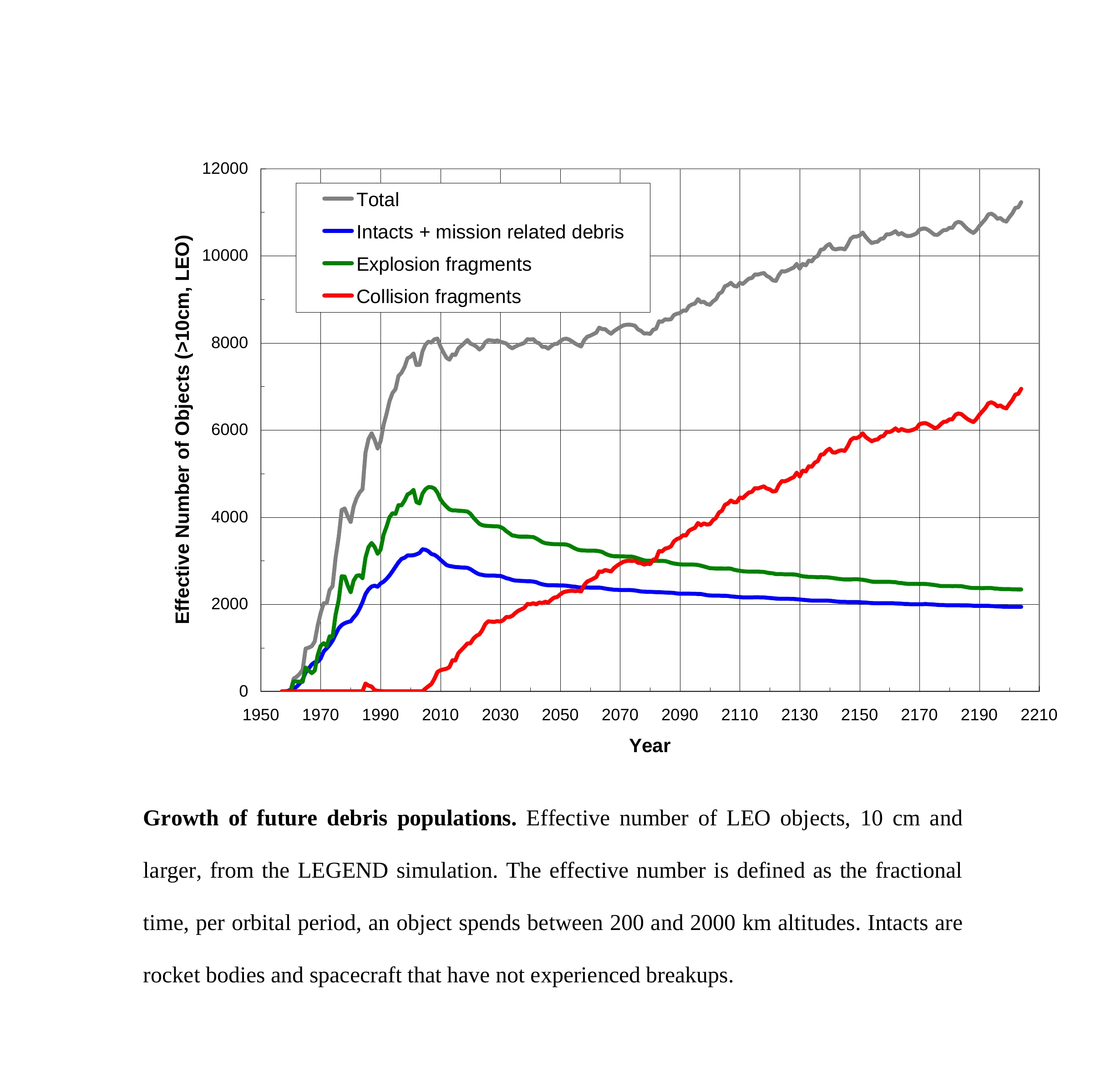
Figure 1: Growth of future debris populations. Effective number of LEO objects, 10 cm and larger, from the LEGEND simulation. The effective number is defined as the fractional time, per orbital period, that an object spends between altitudes of 200 and 2000 km. "Intacts" are rocket bodies and spacecraft that have not experienced breakups. (Source: LEGEND simulation, Liou & Johnson, 2008)
Figure 1 reveals three critical phases of debris evolution:
- 1957–2000 (Historical Phase): The total debris population grows rapidly, primarily driven by explosion fragments (green curve) and intact objects (blue curve). The peak of explosion fragments around 1990 reflects the historical reality of numerous on-orbit rocket body explosions during the Cold War era;
- 2000–2050 (Transition Phase): Explosion fragments begin a slow decline (as intact rocket bodies are depleted), while intact objects decrease through natural decay. However, collision fragments (red curve) accelerate from near zero;
- 2050–2210 (Collision-Dominated Phase): Collision fragments exceed the intact population around 2060 and surpass explosion fragments around 2080, becoming the dominant source of LEO debris. By 2210, collision fragments alone approach 7,000 objects (>10 cm), pushing the total population beyond 11,000.
The key conclusion is stark: collisional cascading-driven debris growth is inevitable even under the most conservative zero-launch assumption.
3.3 Evolution of Spatial Density Distribution
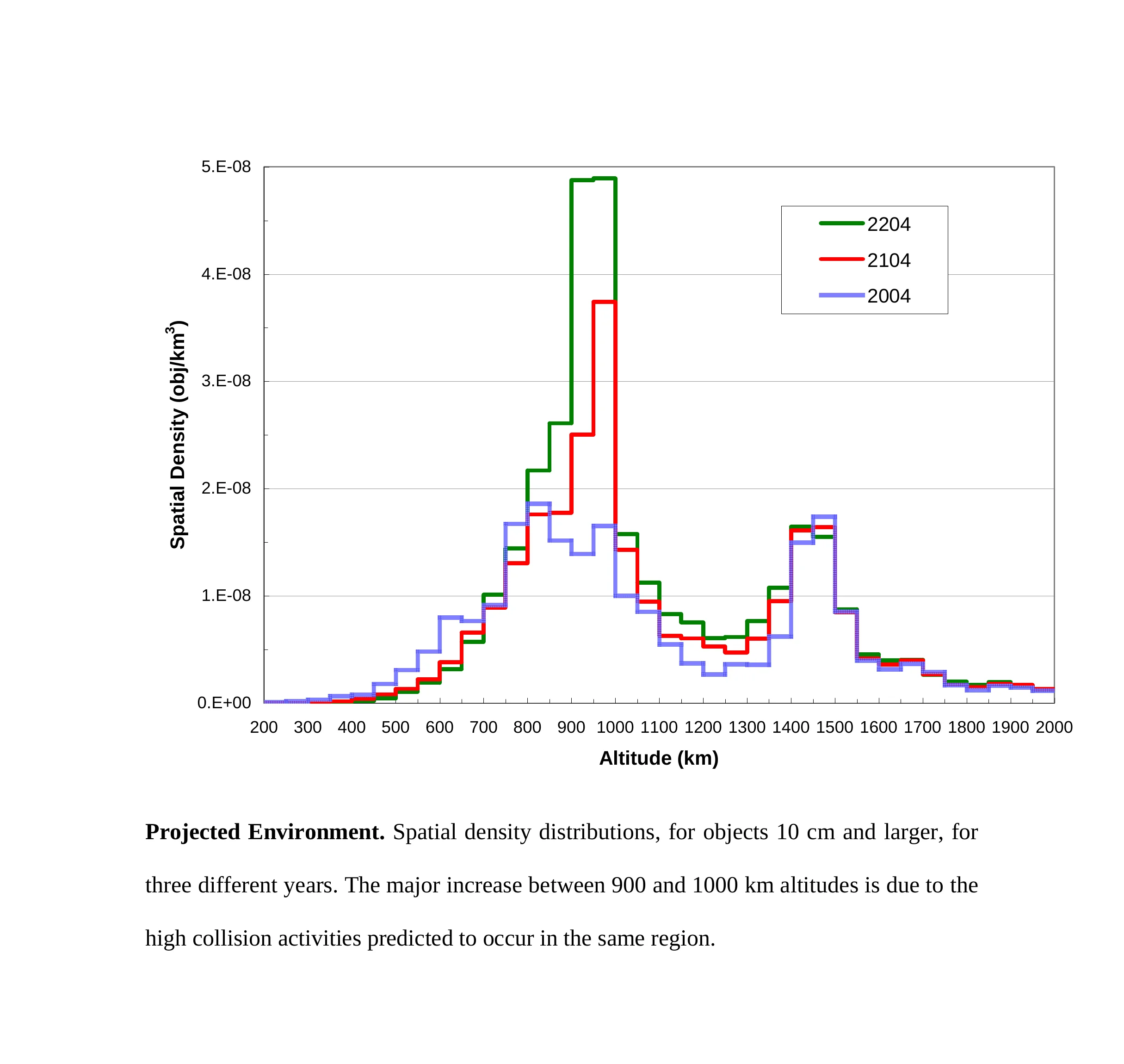
Figure 2: Projected environment. Spatial density distributions for objects 10 cm and larger at three different years (2004, 2104, and 2204). The major increase between 900 and 1000 km altitudes is due to the high collision activities predicted to occur in the same region.
Figure 2 provides a more refined spatial perspective. The three curves correspond to the spatial density distribution in 2004 (baseline), 2104, and 2204:
- Baseline (2004, blue): Two modest peaks appear near 800 km and 1400 km — historically the most commonly used orbital altitudes;
- 100 years later (2104, red): A pronounced spatial density spike emerges in the 900–1000 km altitude band (reaching approximately $3.8 \times 10^{-8} \text{ obj/km}^3$), far exceeding the baseline;
- 200 years later (2204, green): The same altitude band sees density climb to nearly $5.0 \times 10^{-8} \text{ obj/km}^3$.
The 900–1000 km altitude band becomes a debris "hotspot" for three reasons:
1. The atmosphere at this altitude is exceedingly thin, giving debris orbital lifetimes of centuries to millennia;
2. Historically, large numbers of spacecraft and rocket bodies have been deployed in this region;
3. High spatial density dramatically elevates collision probability, triggering the cascading effect.
3.4 "The Red Zone": 900–1000 km
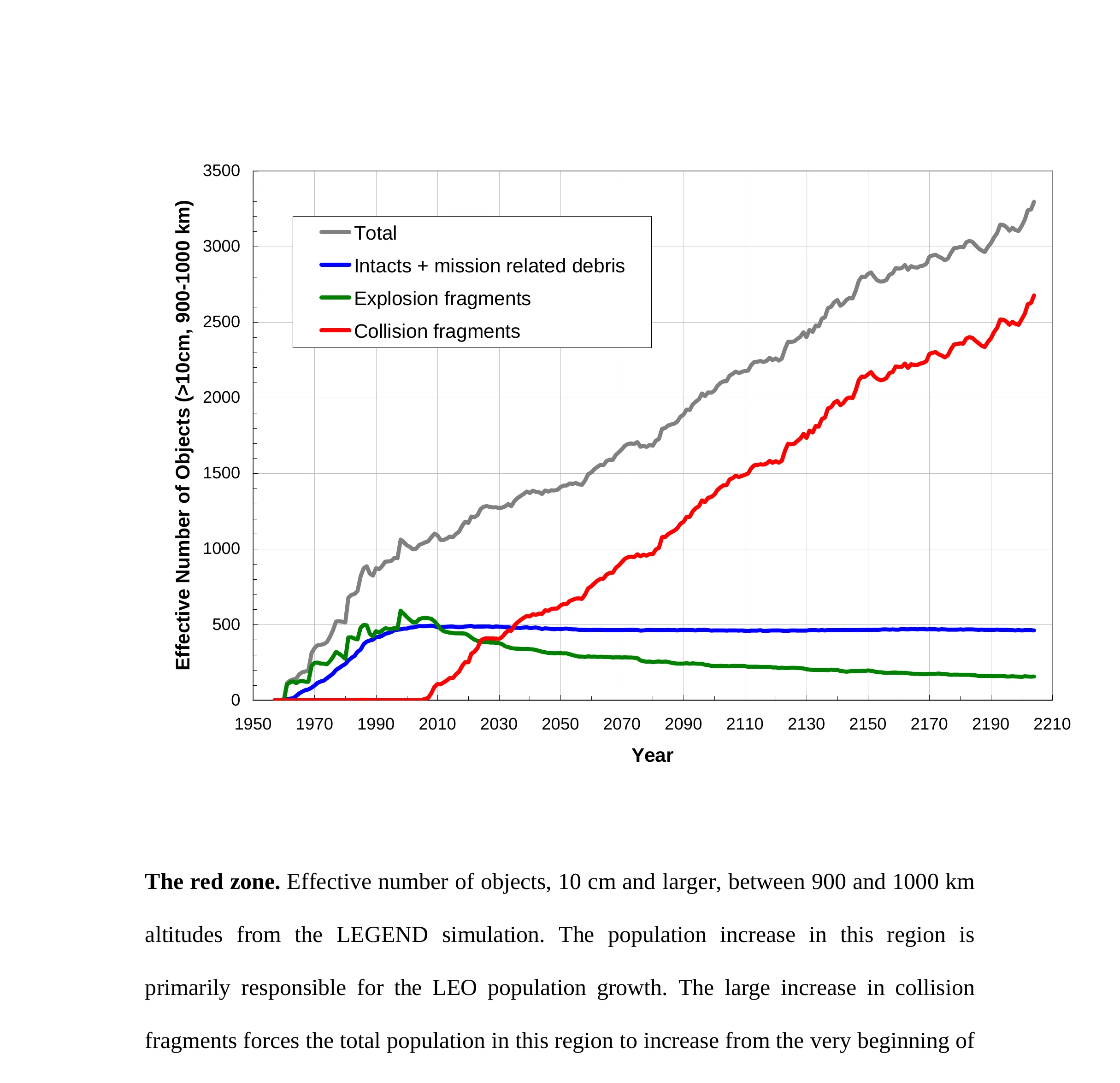
Figure 3: The red zone. Effective number of objects, 10 cm and larger, between 900 and 1000 km altitudes from the LEGEND simulation. The population increase in this region is primarily responsible for the LEO population growth.
Figure 3 focuses on the most dangerous altitude band, 900–1000 km. Compared to the LEO-wide trend, this region exhibits earlier and more severe growth:
- The total population in this band begins accelerating as early as 2010 (the LEO-wide trend does not visibly accelerate until after 2050);
- Collision fragments dominate the population increase from the very start of the projection;
- By 2210, the >10 cm object count in this band exceeds 3,000.
Liou and Johnson termed this altitude band "the red zone" because it represents the most unstable and dangerous portion of the LEO debris environment.
4. Mathematical Framework: Critical Spatial Density
4.1 Kessler's Original Criterion
In his 1991 follow-up study, "Collisional cascading: The limits of population growth in low Earth orbit," Kessler formalized the critical spatial density concept. Consider a volume element $V$ at altitude $h$ containing $N$ debris objects. The objects have an average collisional cross-section $A_c$ (on the order of $10^{-6} \text{ km}^2$) and an average relative velocity $v_{\text{rel}}$.
The evolution equation for the debris population can be written as:
$$\frac{dN}{dt} = \dot{N}_{\text{launch}} + \dot{N}_{\text{explosion}} + \dot{N}_{\text{collision}} - \dot{N}_{\text{decay}}$$
where the collision production rate is proportional to the square of the spatial density:
$$\dot{N}_{\text{collision}} \propto \rho^2 \cdot A_c \cdot v_{\text{rel}}$$
Here, $\rho = N/V$ is the spatial density. The critical insight is that the decay rate $\dot{N}_{\text{decay}}$ is very small in high-altitude regions with tenuous atmospheres, while the collision production rate grows as $\rho^2$. Once $\rho$ exceeds a critical value $\rho_c$, we inevitably have $dN/dt > 0$ even when $\dot{N}_{\text{launch}} = 0$ and $\dot{N}_{\text{explosion}} = 0$.
4.2 Collision Probability in LEGEND
Within the LEGEND framework, the per-unit-time collision probability between two objects employs a "kinetic gas" analogy:
$$P_{ij} = s_i s_j \cdot V_{\text{imp}} \cdot \frac{dt}{V_{\text{bin}}}$$
where:
- $s_i, s_j$ are the collisional cross-section radii of objects $i$ and $j$;
- $V_{\text{imp}}$ is the average impact velocity between the two objects;
- $V_{\text{bin}}$ is the volume of the spatial grid cell.
LEGEND divides the LEO region into hundreds of altitude-latitude-longitude grid cells, computing collision probabilities independently within each cell, thereby achieving spatially resolved debris evolution simulation.
5. Implications for Debris Mitigation Policy
The Liou and Johnson study yielded several conclusions with profound implications for space debris mitigation policy:
5.1 Mitigation Alone Is Insufficient
For decades, the international space community has primarily focused on mitigation strategies — limiting the generation of new debris. These measures include:
- The 25-year rule (LEO spacecraft must re-enter within 25 years of mission completion);
- Passivation measures (depleting residual propellant and battery energy after mission end to prevent on-orbit explosions);
- Reducing the release of mission-related debris (separation bolts, lens caps, etc.).
However, LEGEND simulation results demonstrate that even full implementation of these mitigation measures can only delay, not prevent, the continued growth of the debris population. The reason is that sufficient "seed" debris already exists in orbit for collisional cascading to have begun.
5.2 The Necessity of Active Debris Removal
The paper explicitly states that Active Debris Removal (ADR) must become the central focus of future debris management. Specific recommendations include:
- Prioritize large-mass objects: Large rocket bodies and defunct spacecraft (mass > 1,000 kg) are the primary sources of future collision fragments;
- Target the "red zone": The 900–1000 km altitude band should be the priority target region for ADR;
- Act quickly: Every year of delay allows the collisional cascading effect to intensify further, increasing remediation costs accordingly.
6. Summary and Outlook
The 2008 study by Liou and Johnson represents a watershed moment in space debris environment evolution research. Through high-fidelity Monte Carlo simulations with the LEGEND model, the study delivered an inescapable conclusion: even with an immediate cessation of all launch activities, the triggering of the Kessler Syndrome is already unavoidable.
The study's key contributions can be summarized as:
- Quantitatively demonstrated debris population instability: Under the zero-launch assumption, collision fragments will drive continuous growth of the total debris population beyond 2050;
- Identified the "red zone": The 900–1000 km altitude band is where collisional cascading is triggered first and most severely;
- Catalyzed a policy shift: From a sole focus on "mitigation" to an urgent call for "active remediation."
As of today (2026), with the rapid deployment of megaconstellations such as Starlink and OneWeb, LEO spatial density has increased further. Liou and Johnson's warning has not become obsolete — on the contrary, it is more urgent than ever. For aerospace engineering graduate students, a deep understanding of debris environment evolution mechanisms is not merely an academic requirement, but essential knowledge for future orbit design, collision avoidance, and space traffic management practice.
References:
- Kessler, D. J., & Cour-Palais, B. G. (1978). Collision frequency of artificial satellites: The creation of a debris belt. Journal of Geophysical Research: Space Physics, 83(A6), 2637–2646.
- Kessler, D. J. (1991). Collisional cascading: The limits of population growth in low earth orbit. Advances in Space Research, 11(12), 63–66.
- Liou, J.-C., & Johnson, N. L. (2006). Risks in space from orbiting debris. Science, 311(5759), 340–341.
- Liou, J.-C., & Johnson, N. L. (2008). Earth satellite population instability: Underscoring the need for debris mitigation. NASA Johnson Space Center.
- Liou, J.-C., Hall, D. T., Krisko, P. H., & Opiela, J. N. (2004). LEGEND — A three-dimensional LEO-to-GEO debris evolutionary model. Advances in Space Research, 34(5), 981–986.